
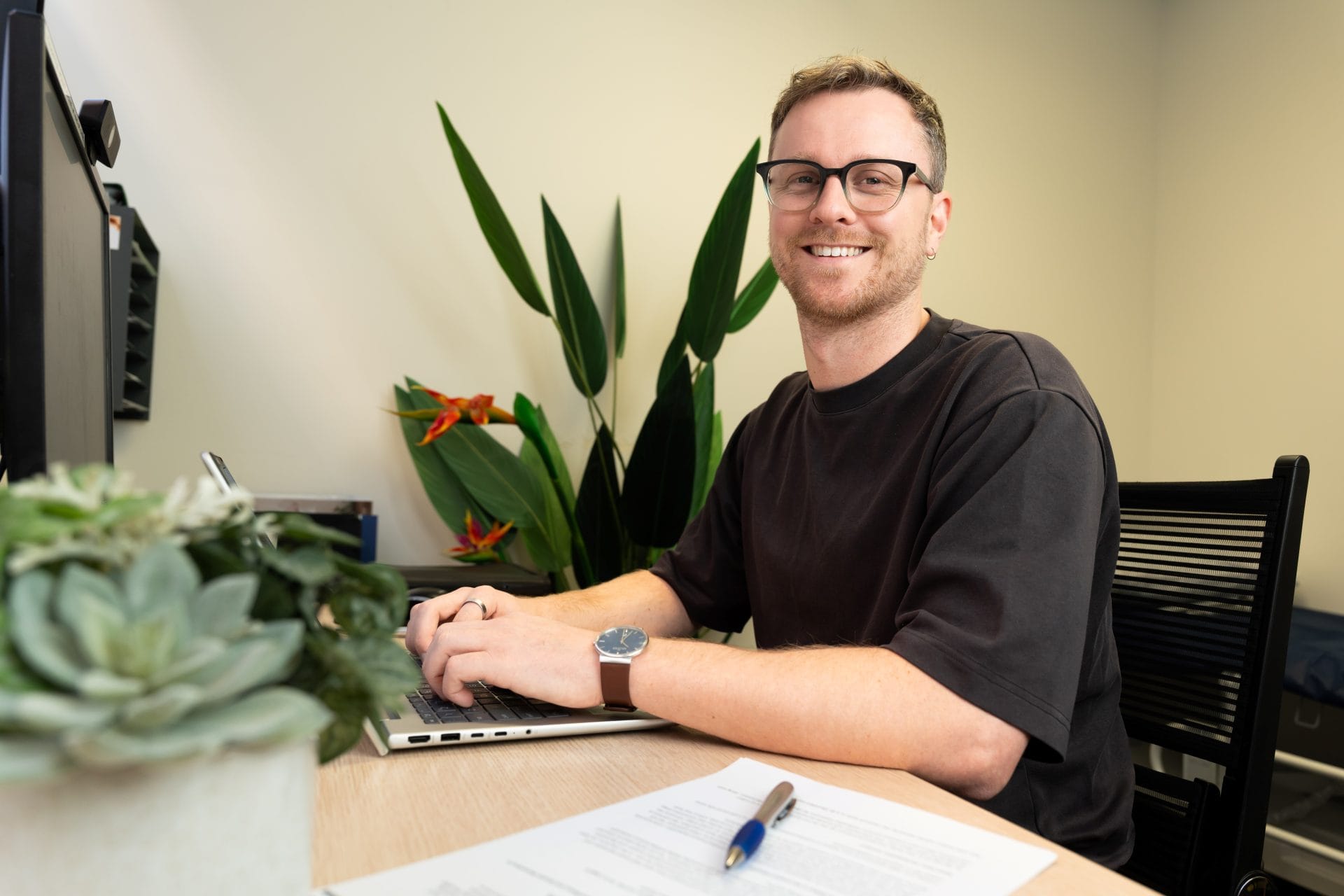
Perron Institute and The University of Western Australia PhD candidate, Bradley Roberts, has been announced as a finalist in the prestigious 2026 Premier’s Science Awards – Student Scientist of the Year category.
Bradley’s research focuses on personalising antidepressant treatments for youth depression via pharmacogenetic testing. This precision psychiatric approach examines how a person’s genetic makeup affects their likely response to certain medications, giving clinicians evidence to select the medication most likely to be effective and well tolerated.
Bradley is the first author of the GENE-YD feasibility pilot study, the main body of work of his PhD, with results to be published soon in Nature portfolio journal, Translational Psychiatry.
This work has helped to attract major research funding, international collaborations, and publications in leading journals. It is also supporting the growth of precision psychiatry in WA through partnerships with local industry and healthcare providers.
Bradley acts as a voluntary Board Director of Kai-Fella, a grassroots youth mental health charity, and is preparing now to move to Canada to take up an opportunity as a post-doctoral scholar at the University of Calgary.
The Premier’s Science Awards program, with ten categories and a People’s Choice award, recognises outstanding achievements in scientific research, study, education and engagement in Western Australia.
Administered by the Department of Energy and Economic Diversification, the awards demonstrate the WA Government’s commitment to raising the profile of science, technology, engineering and mathematics (STEM) across the State.
“It is an honour to be nominated for the WA Premier’s Science Awards’ Student Scientist of the Year,” Bradley Roberts said.
“This recognition helps shine a light on the need for continued innovation in youth mental health research.
“This includes the work being done at the Perron Institute, exploring the potential for pharmacogenetics to help personalise antidepressant prescribing to reduce the burden of trial-and-error treatment for young people.”
“I would like to acknowledge the team that has supported me throughout my PhD. Research like this is never possible in isolation.
“I am especially thankful to my supervisors, Professors Jennifer Rodger, Sean Hood, and Anthony Akkari, my colleagues, collaborators, and the young people and families who have shared with us their time, trust, and lived experiences.”
Image credit: Jarryd Gardner, UWA.